
The $1.2 billion pizza: Bitcoin's most expensive lunch order
On May 22, 2010, a Florida programmer paid 10,000 BTC for two Papa John's pizzas. It remains the most discussed food delivery in financial history — and a strangely useful lesson in what money actually is.
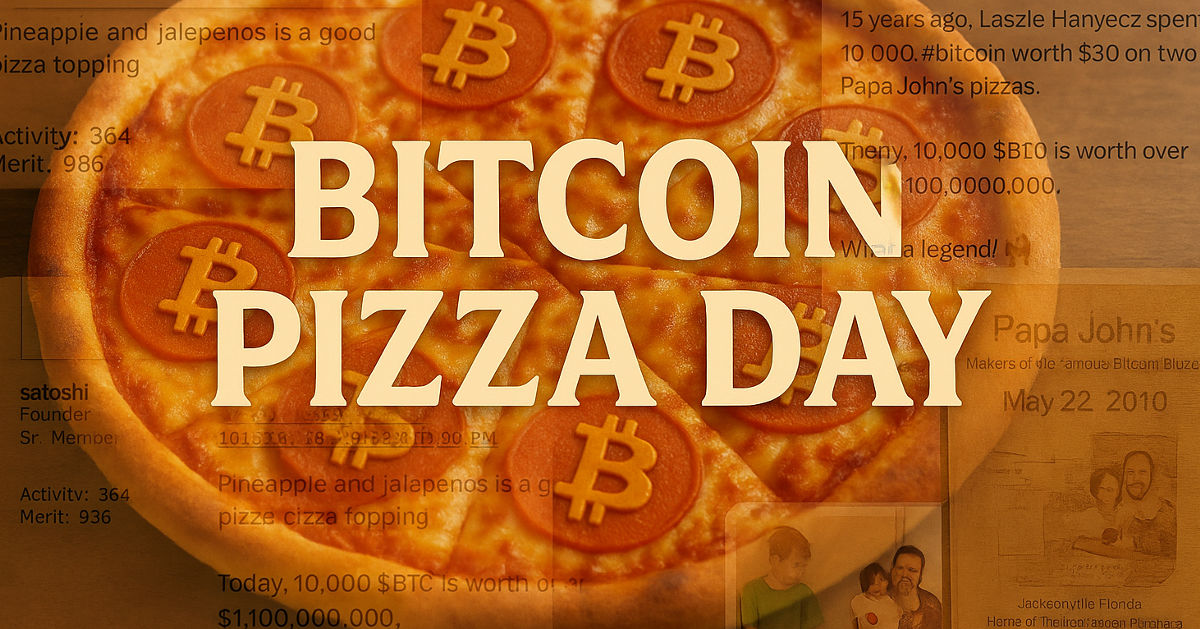
On a Saturday afternoon in Jacksonville, Florida, a programmer named Laszlo Hanyecz got hungry. He also happened to have a stash of a strange new internet money that nobody had ever spent on anything physical. So he did what any reasonable person would do: he went on the BitcoinTalk forum and offered 10,000 BTC to anyone who would order him two pizzas.
"I'll pay 10,000 bitcoins for a couple of pizzas.. like maybe 2 large ones so I have some left over for the next day."
Four days later, on May 22, 2010, a British teenager named Jeremy Sturdivant accepted, called Papa John's, and had two large pizzas delivered to Laszlo's house. Pepperoni, mushrooms, the usual. Total cost: about $41.
Laszlo got his pizza. Jeremy got 10,000 BTC. Everyone went to bed happy.
The math nobody wants to do
At today's prices, those two pizzas cost somewhere north of $1.2 billion. That's roughly $600 million per pie, or about $75 million per slice if you cut them into eighths. The garlic dipping sauce alone would buy you a small island.
Laszlo, to his eternal credit, has never expressed regret. In multiple interviews he's pointed out the obvious thing everyone forgets: at the time, the bitcoins were worth nothing. There was no exchange. There was no price. There was barely a "market." He was the first person to prove the thing could function as money at all, and that proof required someone to actually, you know, spend it.
Why this matters (slightly)
Pizza Day gets celebrated every May 22 as a kind of crypto Thanksgiving, but the lore obscures the actual milestone. Before this transaction, Bitcoin was a curiosity — a clever cryptographic toy traded between cypherpunks for fractions of a cent. After it, Bitcoin had done the one thing money has to do to be money: buy something somebody wanted.
Every store that accepts BTC today, every Lightning payment, every El Salvador beach bar with a QR code on the menu — all of it traces back to one hungry programmer and one confused pizza delivery driver.
What Laszlo says now
Asked repeatedly over the years whether he wishes he'd held those coins, Laszlo has stayed remarkably zen:
"It wasn't like Bitcoins had any value back then, so the idea of trading them for a pizza was incredibly cool. I don't regret it."
This is, depending on your priors, either profound wisdom about the relationship between meaning and money, or the most expensive cope in human history. Possibly both.
The annual ritual
Every May 22, Bitcoiners around the world order pizza, post the receipts, and tell newcomers the story. It's become the closest thing the asset class has to a folk holiday — half origin myth, half cautionary tale, entirely delicious.
If you're holding bitcoin this Pizza Day, here's the only sensible move: order the pizza in fiat. Tip well. And quietly thank Laszlo for being weird enough, ten years ago, to prove the whole thing worked.
Two large pies. Pepperoni and mushrooms. The most important
Related stories
Aztec investigates $2 million exploit of deprecated payments product
Aztec Labs is investigating a $2 million exploit on a deprecated payments product, highlighting security challenges in legacy decentralized systems.
‘The low is almost in’: Standard Chartered says bitcoin bottom near after tough week for crypto
Standard Chartered suggests Bitcoin's market low is "almost in," citing resilient ETF holdings and likely strategic buybacks after a challenging period for crypto.
‘I Should Never Have Called My Bank. It Cost Me Five Million Kroner.’
A 34-year-old’s attempt to do the "right thing" ended in financial disaster. As Norwegian banks lose billions on bad crypto bets, regular customers are being punished for cashing out—raising a critical question: Is your bank blocking you to protect you, or to protect itself?