
El Salvador’s Bitcoin reserve faces an accounting reckoning under new IMF pressure
El Salvador’s Bitcoin reserve is back in the market spotlight because its public one-BTC-a-day narrative has resurfaced just as Bitcoin’s drawdown, IMF conditions, and wallet-accounting questions are pressing on the same policy.
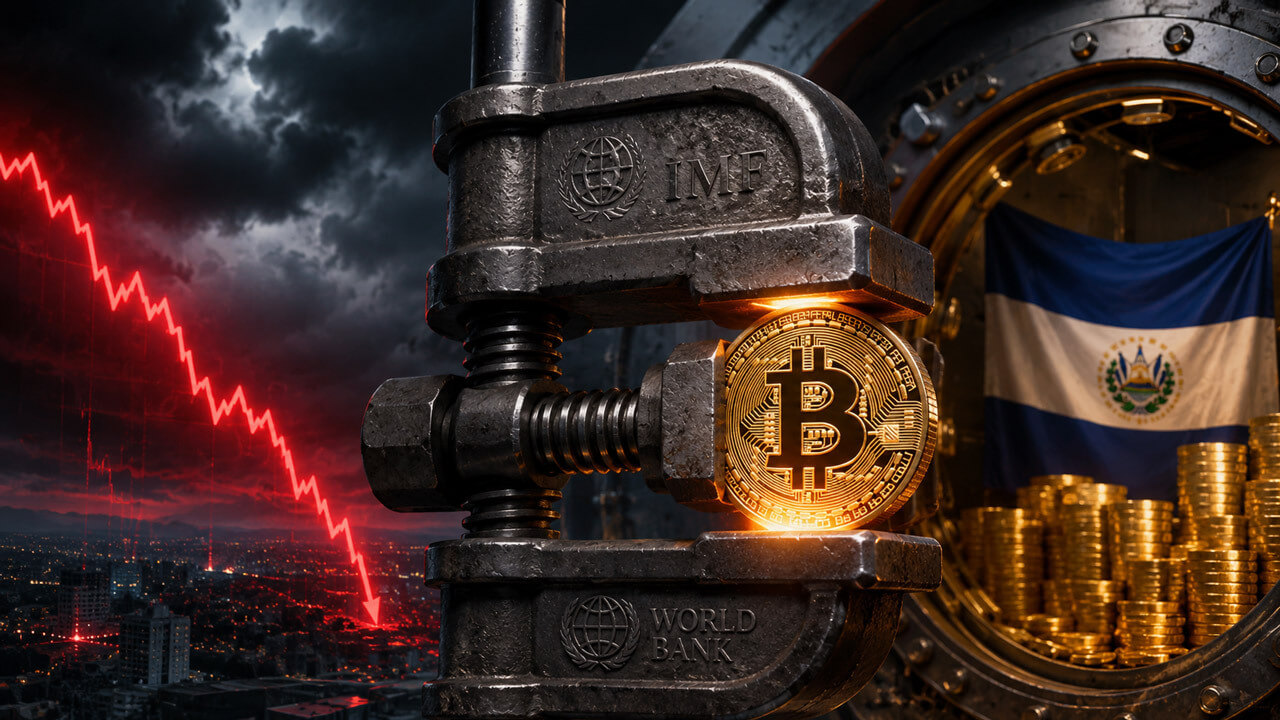
El Salvador’s Bitcoin reserve is back in the market spotlight because its public one-BTC-a-day narrative has resurfaced just as Bitcoin’s drawdown, IMF conditions, and wallet-accounting questions are pressing on the same policy.
BitcoinTreasuries lists El Salvador’s government holdings at 7,696 BTC, worth about $460 million, as of Jun. 28. The figure keeps the country among the largest government-linked Bitcoin holders tracked by the site and gives the renewed debate over its one-Bitcoin-a-day strategy a concrete anchor.
The market backdrop gives that debate urgency. CryptoSlate’s Bitcoin market page showed BTC changing hands around the $59,000 to $60,000 range, after a high-single-digit decline over seven days and an almost 19% drop over 30 days.
The result is a durability test for sovereign accumulation. A daily one-BTC allocation is too small to move the global Bitcoin market on its own, yet it can still indicate whether government dollar-cost averaging behaves differently from ETF demand or corporate treasury demand when the same asset is falling.
Measured against Bitcoin’s roughly $1.2 trillion market value, El Salvador’s 7,696 BTC reserve is a limited market position. It represents a fraction of the Bitcoin supply and is dwarfed by the holdings held by US spot Bitcoin ETFs, exchanges, and the largest corporate treasury buyers.
Measured against sovereign policy, the reserve carries more weight. It is a continuing political signal, a fiscal accounting question, and a test of how far a government can carry a Bitcoin strategy after retreating from the most aggressive version of its legal-tender experiment.
That distinction separates El Salvador from better-known institutional Bitcoin flows. ETF investors can redeem shares. Corporate holders can refinance, issue equity, cut spending, or face pressure from public-market investors.
A government reserve sits inside a different system. It has to coexist with budget targets, external lenders, public accounting, and, in El Salvador’s case, a formal IMF program.
The table also shows the core ambiguity. El Salvador can keep a Bitcoin reserve in the public eye, while the IMF record focuses on the overall public-sector Bitcoin stock and the conditions attached to an Extended Fund Facility. The durability test lives in that gap.
El Salvador’s original Bitcoin policy was built around public adoption, legal-tender status, and a president willing to turn BTC purchases into a national brand. The latter IMF program changed the operating environment.
In a March 2025 press briefing, the IMF said reforms had made Bitcoin acceptance voluntary in the private sector, made taxes payable only in US dollars, and committed the government to avoiding the accumulation of Bitcoin at the overall public-sector level.
The fund’s first review materials then put sharper mechanics around that approach, including a continuous quantitative performance criterion with a zero ceiling on voluntary BTC accumulation by the public sector and a zero ceiling on public-sector BTC-denominated or BTC-indexed debt and tokenized instruments.
That language leaves El Salvador’s Bitcoin reserve in place while changing how it must be understood.
Before the IMF program, a public one-BTC-a-day pledge could be understood mostly as political signaling and Bitcoin accumulation. After the program, the same public message appears next to the program criteria that assess whether the public sector is voluntarily increasing exposure.
The question now is whether visible reserve increases, daily purchase claims, and wallet movements add net public-sector BTC, or whether they are accounting movements inside an already committed stock.
CryptoSlate previously reported that the IMF characterized apparent increases in El Salvador’s Strategic Bitcoin Reserve Fund as consolidation across government-owned wallets rather than new accumulation by the public sector as a whole.
That distinction is technical but central. A reserve can appear larger in one public-facing wallet or tracker without necessarily violating a no-accumulation commitment, provided the underlying public-sector stock remains unchanged.
El Salvador still wants to be seen as a Bitcoin country. The unresolved issue is whether the public signal, wallet accounting, and IMF program conditions can continue to align as Bitcoin prices fall and scrutiny rises.
The market backdrop shows how other Bitcoin demand channels are reacting under stress.
CryptoSlate recently reported roughly $5.94 billion in US spot Bitcoin ETF outflows over six straight weeks, raising the question of whether the ETF complex had just seen its first real capitulation event.
Related stories

AI researcher claims he's already bypassed Anthropic's Fable 5 guardrails
An AI researcher claims to have bypassed Anthropic's Fable 5 guardrails within 48 hours of launch, raising concerns about AI safety and potential implications for cryptocurrency security.
Belgian Banking Giant KBC Accused of Manipulation as Crypto Platforms Prepare Legal Action
Major cryptocurrency exchanges are preparing lawsuits against KBC Bank over allegations of disseminating false information to customers, effectively trapping billions in traditional banking products. As the legal battle intensifies, questions emerge about whether Belgian banks are prioritizing their own commercial interests over customer financial freedom.

Q-Bit – The Quantum Leap Your Portfolio Has Been Waiting For
Stop buying machines. Start owning the future. Q-Bit unlocks quantum computing power for research, logistics, and data protection—without the hardware headache. Here’s why early adopters are already calling it the next paradigm shift.