
Ethiopia's Bitcoin Mining Capacity Doubles on Renaissance Dam Power
The country's total hashrate reached 4.1 EH/s in March, making it the fastest-growing mining jurisdiction in the world. The government sees the industry as a dollar-earning export.
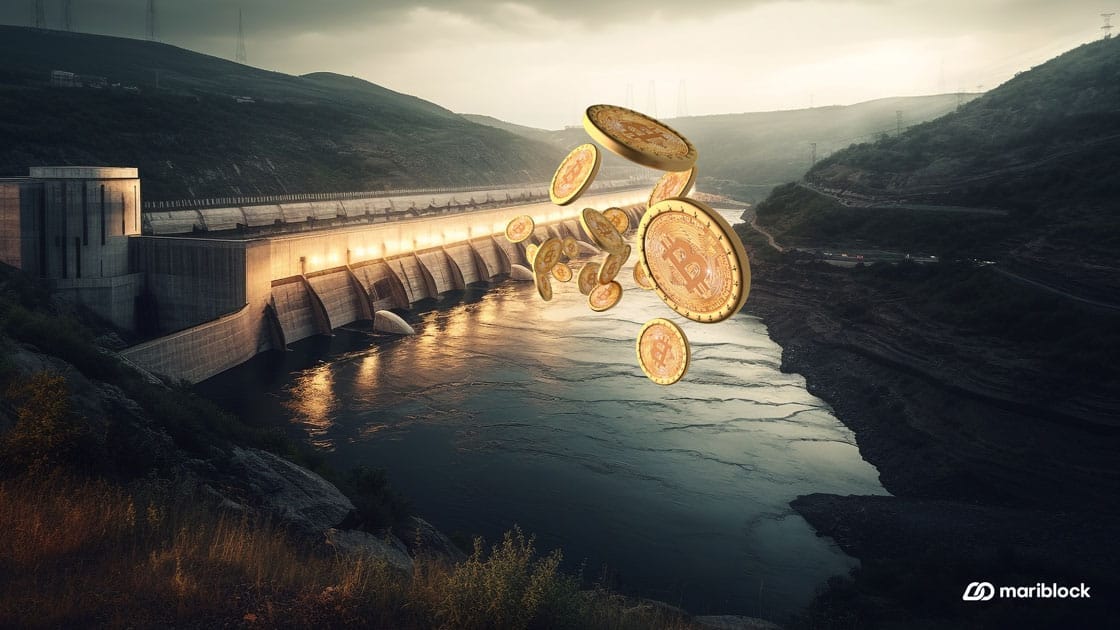
Ethiopia's Bitcoin mining capacity doubled in Q1, reaching approximately 4.1 exahashes per second by the end of March, according to data compiled by Hashrate Index. The country is now the world's fastest-growing mining jurisdiction by percentage, and — more surprisingly — is now in the top ten globally by absolute capacity.
What is driving the growth
The Grand Ethiopian Renaissance Dam came fully online in late 2024 after more than a decade of construction. The dam has added approximately 5.15 gigawatts of generating capacity to the national grid, more than doubling the country's pre-dam generation. The dam's output exceeds Ethiopia's domestic demand by a substantial margin. Mining operations, which can be sited close to the dam and which consume power at a predictable baseload pattern, have been one of the earliest beneficiaries.
The government's approach has been unusually welcoming by recent standards. Ethiopia's Investment Commission designated cryptocurrency mining as an export-oriented industry in late 2024, qualifying operators for streamlined licensing and for access to the same investment incentives available to traditional manufacturing exporters. The categorization is clever: mining's output, measured in Bitcoin, is in effect a foreign-currency-generating export even though the commodity never leaves the country physically.
"We are not positioning mining as a crypto policy. We are positioning it as a foreign exchange policy. The distinction matters for how we regulate it." — Mamo Mihretu, governor of the National Bank of Ethiopia
The operators
The mining capacity growth has been driven by a mix of foreign and domestic operators:
- Bitfarms (Canada): 280 MW live, additional 160 MW under construction
- MARA (US): joint venture with a local partner, 220 MW live
- Iris Energy (Australia): 140 MW, smaller scale pilot
- Several Chinese-affiliated operators, whose exact capacity is harder to measure
- A growing domestic operator cohort, mostly below 50 MW individually
The Chinese operators are notable. After Kazakhstan's tariff changes, a portion of the Chinese diaspora mining capital that had been based there has relocated to Ethiopia, attracted by the power economics and by the less adversarial policy environment.
The power cost comparison
Ethiopian mining operations report all-in power costs in the $0.028-0.034 per kWh range. That compares to:
- Texas: $0.045-0.065
- Paraguay: $0.038-0.045
- Oman: $0.040-0.050
- Russia: $0.025-0.032 (but politically radioactive)
- Iran: $0.015-0.020 (but operationally near-impossible)
Ethiopia's cost advantage over the U.S. mid-range is substantial — roughly 40%. The cost advantage translates directly into margin at current BTC prices.
The long-run question
Ethiopia's current approach is favorable, but the country's history of policy changes — driven by conflict, by IMF program conditions, and by domestic political shifts — creates a non-trivial probability that the current environment does not sustain. Operators entering the country now are betting that the 5-7 year payback period required to recoup ASIC and infrastructure investment will be completed before policy risk materializes. Some of them will win that bet. Some will not. The aggregate capacity growth is, nevertheless, the largest positive story in mining geography this year.
Related stories

Bitcoin miners using AI as a bear market escape plan just got a new rival in Elon Musk
Elon Musk’s SpaceX has turned one of the world’s largest artificial intelligence clusters into a commercial compute product, creating a new challenge for Bitcoin miners racing to recast themselves as AI infrastructure companies. Anthropi...

Marathon Earnings Beat on AI Diversification as Pure-Play Mining Margin Narrows
MARA reported a 12% revenue beat on Wednesday, driven largely by its HPC colocation business. Pure-play hash revenue margins compressed again, as they have every quarter since the halving.

Bitcoin Mining Difficulty Hits All-Time High Eleven Months After the Halving
The hashrate has fully absorbed the reward cut. New ASIC deployments in West Texas and Ethiopia are pushing the network's compute toward a new equilibrium.