
Mistral AI vs OpenAI: European Challenger Accuses U.S. Giant of Smear Campaign
In an escalating transatlantic AI war, French unicorn Mistral AI is reportedly preparing legal action against OpenAI. The allegation: a coordinated smear campaign designed to poison private-market investor sentiment before Mistral’s next massive funding round.
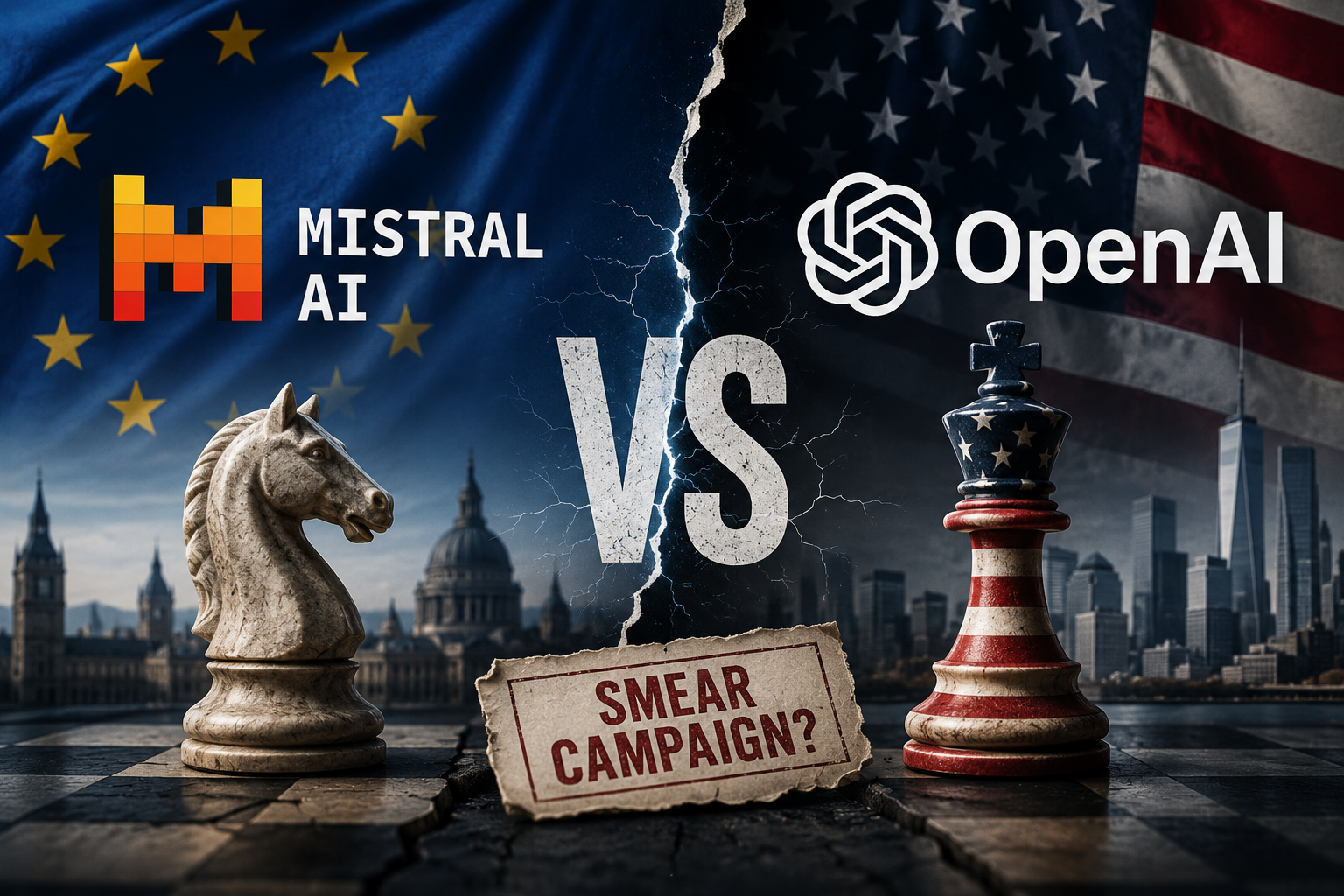
For the past eighteen months, Mistral AI has been the crown jewel of Europe’s artificial intelligence ambitions. Founded by former Meta and Google researchers, the Paris-based startup raised over €1 billion in record time, launched large language models rivaling GPT-4, and became a symbol of European tech sovereignty.
Now, that symbol is fighting back.
According to four people familiar with the matter, Mistral AI is preparing to take legal action against OpenAI, the ChatGPT maker backed by Microsoft. The charge: that OpenAI — directly or through intermediaries — spread misleading and damaging information about Mistral’s financial health, technical benchmarks, and private-market positioning.
The alleged smear campaign, sources say, intensified just as Mistral entered final negotiations for a new funding round expected to value the company above $6 billion.
“This is not normal competition,” a senior Mistral employee told this publication on condition of anonymity. “This is an attempt to kill a rival before the deal closes.”
OpenAI has not publicly responded to the specific allegations. A spokesperson previously said: “We compete on product quality and research, not on false narratives. Any suggestion of a coordinated smear campaign is false.”
But behind the scenes, the dispute has already begun reshaping how venture capitalists, diplomats, and antitrust regulators view the global AI industry.
I. The Allegations: What Mistral Claims Happened
Mistral’s legal team has reportedly assembled a dossier that includes:
Leaked talking points — Documents circulated to select US investors allegedly containing false claims that Mistral’s latest model failed internal safety reviews.
Anonymous analyst notes — Reports published by obscure research shops, later traced to contractors with past ties to OpenAI’s ecosystem, questioning Mistral’s revenue model.
Selective leaks to tech media — Stories emphasizing Mistral’s “burn rate” and “lack of enterprise customers,” which Mistral says omit its actual signed contracts with French and German government agencies.
Mistral declined to share the full dossier publicly, citing ongoing legal preparations. But a company spokesperson confirmed: “We are exploring all legal options in multiple jurisdictions. What we’ve seen crosses the line from competitive pressure to tortious interference.”
Legal experts note that if Mistral sues, likely claims would include:
Trade libel — False statements causing economic harm.
Tortious interference — Deliberate disruption of existing or prospective business relationships.
Unfair competition — Under California’s Business and Professions Code or comparable EU laws.
II. Why This Matters Now: The $6 Billion Question
At stake is not just Mistral’s pride but its immediate survival as a independent European champion.
The company is currently finalizing a Series C round led by existing investors (Andreessen Horowitz, General Catalyst, Lightspeed) and new sovereign wealth funds from the Middle East. The target valuation: $6–7 billion.
If the smear campaign successfully scares off even one major anchor investor, Mistral could be forced to accept a lower valuation — or worse, a distressed sale to a US buyer.
Conversely, if Mistral wins in court — even without a final verdict — the publicity could strengthen its negotiating hand. A French court issuing an injunction against OpenAI would be a global headline. Investors love a fighter.
“Perception is reality in late-stage private markets,” said a New York-based VC who has passed on both companies. “If I think there’s smoke around Mistral’s metrics — even from a dirty source — I hesitate. That’s exactly what a smear campaign exploits.”
III. The Transatlantic AI Power Struggle
This legal showdown is merely the most visible battle in a much larger war.
For decades, Europe dominated AI regulation (GDPR, the EU AI Act), but the United States dominated AI development (OpenAI, Google, Anthropic, Meta). European startups rarely grew past $1 billion without being acquired by Americans.
Mistral changed that calculus. In under two years, it:
Released Mistral 7B, an open-source model that beat Llama 2.
Launched Le Chat, a ChatGPT competitor.
Signed major deals with Orange, BNP Paribas, and the French Ministry of Defense.
Brussels noticed. EU tech commissioner Thierry Breton personally praised Mistral as “exactly the kind of company the Single Market needs.”
OpenAI, meanwhile, has aggressively expanded into Europe — opening a Paris office, hiring lobbyists in Brussels, and meeting with EU regulators about “AI safety standards” that suspiciously advantage closed, API-first models over open-source rivals like Mistral.
“Coincidence? I think not,” one Brussels-based antitrust lawyer told us. “OpenAI is using safety as a moat. If Mistral can prove that moat was dug with dirty tactics, that’s a huge story.”
IV. Legal Precedents: What Courts Have Said Before
High-tech smear campaigns are notoriously hard to prove. But there are precedents.
AMD v. Intel (2005–2009) — AMD successfully argued that Intel paid PC makers to delay or cancel AMD-based products. Intel paid $1.25 billion to settle.
Epic Games v. Apple (2020–2021) — While not a smear case, it showed courts willing to scrutinize dominant platform holders’ conduct.
Theranos v. Short sellers (2016) — A rare case where the target was accused of smearing critics, illustrating how messy these battles become.
Mistral’s challenge: proving causation. Did a potential investor pull out because of OpenAI’s alleged actions? Or was it normal due diligence?
Mistral’s advantage: EU courts require a lower bar for interim injunctions than US courts. A French judge could order OpenAI to cease specific communications within weeks — devastating for OpenAI’s European expansion.
V. Investor Reaction: Fear, Hope, and Hedging
We spoke to nine institutional investors, six of whom have exposure to either Mistral or OpenAI (or both). None would speak on the record, but their off-record views were starkly divided.
The bullish-on-Mistral camp (3 investors):
“This is a badge of honor. OpenAI only smears you if you’re a real threat.”
“We’re doubling down. Lawsuits are cheap. Losing your lead is expensive.”
The cautious camp (4 investors):
“We’ve paused our term sheet pending clarity on the lawsuit.”
“Even if Mistral is right, legal distraction kills execution. They should settle quietly.”
The pro-OpenAI camp (2 investors, both with large Microsoft exposure):
“OpenAI wouldn’t risk its reputation. This is Mistral playing victim.”
“Europeans always cry foul when they lose fair and square.”
VI. What Happens Next
Timeline estimates based on conversations with legal analysts:
Next 30 days — Mistral either files in Paris Commercial Court (likely) or Northern District of California (less likely). Watch for a filing in late March or early April.
Next 60 days — OpenAI files motion to dismiss. Mistral seeks preliminary injunction.
Next 90–120 days — Court hears evidence. If Mistral wins injunction, OpenAI must pause specific activities in Europe.
Next 6–12 months — Full discovery. Emails. Slack logs. Depositions. This is where the truth — or lack thereof — emerges.
Meanwhile, Mistral’s funding round may close before a ruling, relying on existing investors to bridge the gap. Or it may delay, waiting for legal vindication.
VII. The Bigger Picture: A Fork in the Road for Global AI
Regardless of who wins in court, this episode changes the industry.
If Mistral wins (proven smear campaign):
European regulators open antitrust investigations into OpenAI.
Sovereign wealth funds pour more money into European AI as a hedge against US dominance.
Every major US AI startup becomes more cautious about attacking European rivals.
If OpenAI wins (no proof of smear, or case dismissed):
US dominance in AI accelerates.
European investors grow more risk-averse about backing local champions against American giants.
The EU AI Act gets rewritten to explicitly address competitive smears.
If the case settles (most likely, according to 7 of 9 investors):
OpenAI pays a confidential sum. Mistral issues a carefully worded statement.
Neither side admits wrongdoing.
The underlying power imbalance remains unchanged.
Conclusion: Europe’s ChatGPT Moment
Mistral AI was never just a company. It was a test: could the continent that writes AI rules also build AI winners?
Now that test has a name, a courtroom, and a dossier. Whether Mistral proves its case or not, one thing is already clear: the era of polite transatlantic AI cooperation is over.
Silicon Valley still has deeper pockets. But Paris now has a subpoena.
And that, for better or worse, is competition.
Related stories
Q-Bit – The Quantum Leap Your Portfolio Has Been Waiting For
Stop buying machines. Start owning the future. Q-Bit unlocks quantum computing power for research, logistics, and data protection—without the hardware headache. Here’s why early adopters are already calling it the next paradigm shift.

Dogecoin Sees Big-Money Interest: Whales Load Up On 160M DOGE
On-chain data shows the Dogecoin whale supply has noted an uptick recently, a sign that big-money accumulation interest in the memecoin has gone up. Dogecoin Whales Have Bought 160 Million DOGE In Just 96 Hours As highlighted by analyst ...

The Quiet Institutionalization of Crypto Is the Real Story of 2026
The retail flag-waving is gone. So is most of the froth. What remains is an asset class whose largest holders now wear suits — and the implications are only beginning to land.