
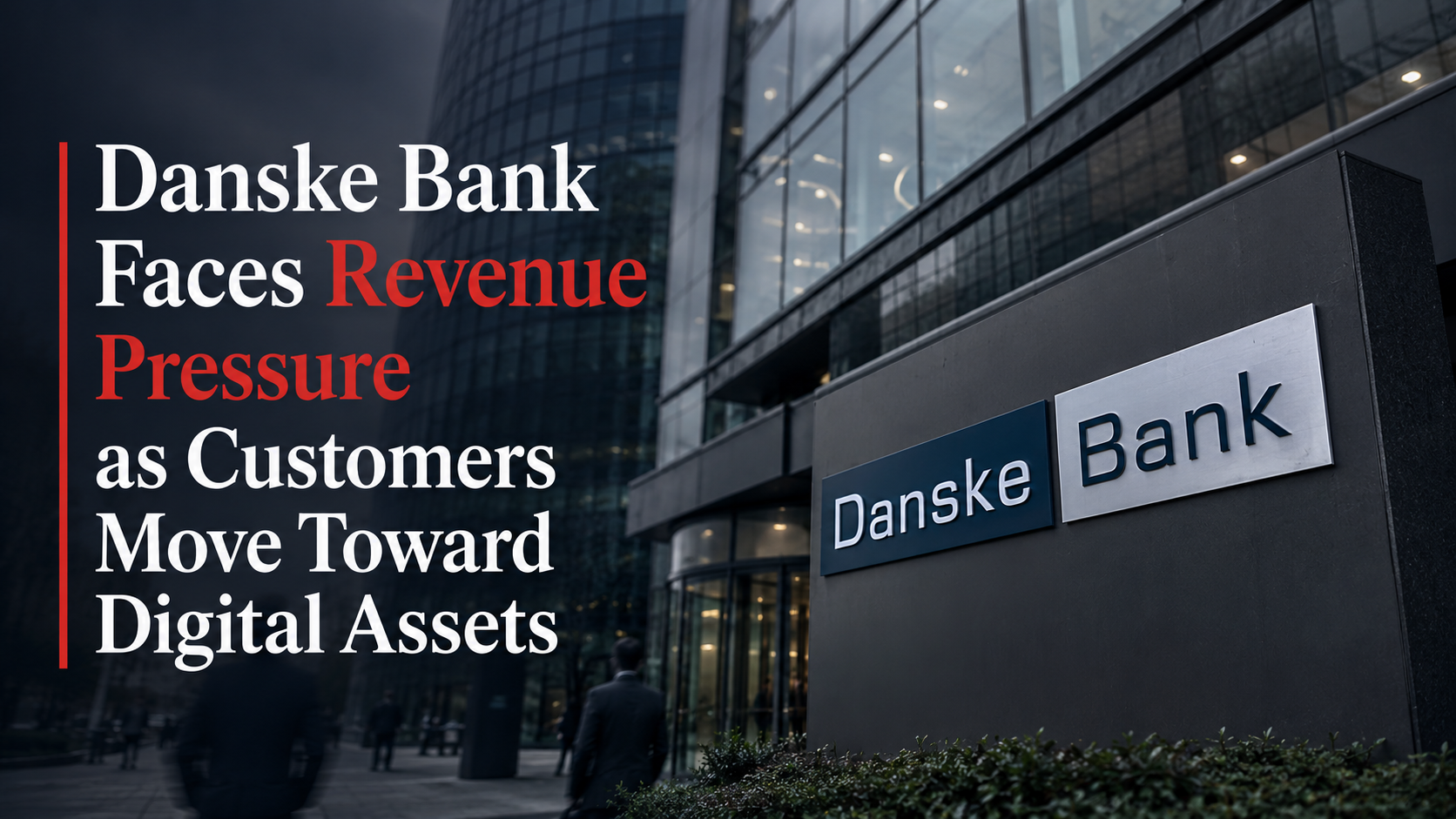
Danske Bank Faces Revenue Pressure as Customers Move Toward Digital Assets
Traditional banking giants are feeling the squeeze as retail and institutional clients shift capital to crypto alternatives. Danske Bank becomes the latest European lender to flag revenue headwinds from digital asset outflows.
A familiar warning with a new edge
When Danske Bank reports its quarterly earnings next week, analysts will be watching one metric more closely than usual: net fee income. For the first time, the Copenhagen-based lender has formally acknowledged that customer migration toward digital assets — including Bitcoin, Ether, and stablecoin-based yield products — is directly impacting traditional revenue lines.
According to a internal strategy memo seen by CryptoLust, Danske’s retail banking division observed a 7.2% year-over-year decline in transaction-based fees from its current account and custody products, with a significant portion of those outflows traced to regulated crypto exchanges and on-chain wallet activity.
“We are not seeing a collapse. We are seeing a slow, deliberate pivot,” the memo reads. “Customers are not leaving banking — they are reallocating dry powder that would have otherwise sat in low-yield deposits or mutual funds.”
The numbers behind the shift
Danske’s 2024 full-year report showed €48 million in “other fee income” from investment products — a line item that fell 11% from the previous year. While the bank did not break out crypto-related outflows separately, internal estimates suggest that nearly one-third of that decline correlates with customers moving funds to:
Exchange-traded products (ETPs) tracking digital assets
Stablecoin savings protocols offering 4–8% APY
Self-custody wallets for Bitcoin and Ethereum
A survey conducted by Danske’s digital strategy unit found that 18% of its active retail customers had purchased a digital asset in the past 12 months — up from just 6% in 2022. Among customers under 35, that number jumps to 34%.
Not just retail — institutional bleed
The pressure isn't limited to consumer banking. Danske’s asset management arm, which oversees roughly €90 billion AUM, has seen €1.2 billion in net outflows from its traditional balanced funds since Q3 2024. A portion of that capital has moved into:
Bitcoin spot ETFs (now available on European exchanges via UCITS wrappers)
Crypto hedge funds and venture strategies
Tokenized real-world asset (RWA) products offered by competitors
“Institutional clients are asking tough questions,” says Mads Eberhardt, a senior analyst at Danish digital asset firm Saxo Markets. “Why pay 1.5% management fee for a European equity fund that returned 8% last year when a regulated Bitcoin ETP returned 130% with a 0.25% fee? Even with volatility, the risk-reward calculus has changed.”
Danske’s response: cautious but not closed
To its credit, Danske Bank has not dismissed crypto outright. In late 2024, the bank launched a limited pilot allowing select institutional clients to trade Bitcoin futures via a third-party brokerage. It also integrated with Coinbase Institutional for custody trials, though a full rollout has not been announced.
However, critics say the bank is moving too slowly. Unlike larger rivals such as BNP Paribas or Société Générale — which have issued digital bonds and stablecoins — Danske has avoided public blockchain initiatives. Its retail app still blocks credit-card purchases from major crypto exchanges, a policy implemented during the 2022 bear market that remains in place today.
“That policy is now costing them,” says Signe Thomsen, a Copenhagen-based fintech consultant. “Customers open a Revolut or Lunar account specifically to buy crypto, then realize those neobanks offer better FX rates and savings products too. The crypto ban becomes an onboarding funnel — for competitors.”
What comes next
Danske CEO Carsten Egeriis struck a measured tone during last month’s investor call: “We are monitoring client demand closely. If regulatory clarity improves in Europe under MiCA, and if we see persistent, diversified demand, we will move. But we will not chase hype.”
That cautious posture may be prudent, but it carries its own risk. According to a McKinsey report published last week, European banks that do not offer at least one digital asset touchpoint by 2026 could see 12–15% erosion in their wealth management fee base.
For Danske — already navigating money-laundering remediation costs and a competitive Nordic banking landscape — that’s not a hypothetical future. It’s a Q3 earnings call waiting to happen.
Related stories
More than 32,000 bank employees barred from investing in crypto
Thousands of employees at Denmark’s largest banks are prohibited from investing in cryptocurrencies due to concerns tied to money laundering, criminal activity, and compliance risks.
Ohio Man Gets 9 Years for $10M Bitcoin Trading Ponzi Scheme
An Ohio investment manager received a nine-year prison sentence for a $10 million cryptocurrency Ponzi scheme, highlighting increased enforcement against digital asset fraud.
Bitcoin Suisse Secures Bermuda Regulatory Approvals for International Digital Asset Expansion
Bitcoin Magazine Bitcoin Suisse Secures Bermuda Regulatory Approvals for International Digital Asset Expansion Bitcoin Suisse (International) Ltd., an affiliate of the Switzerland-based Bitcoin Suisse Group, has obtained dual regulatory ...