
Rabobank Revenue Falls 28% as Customers Flock to Neobanks Offering Better Rates and Faster Service
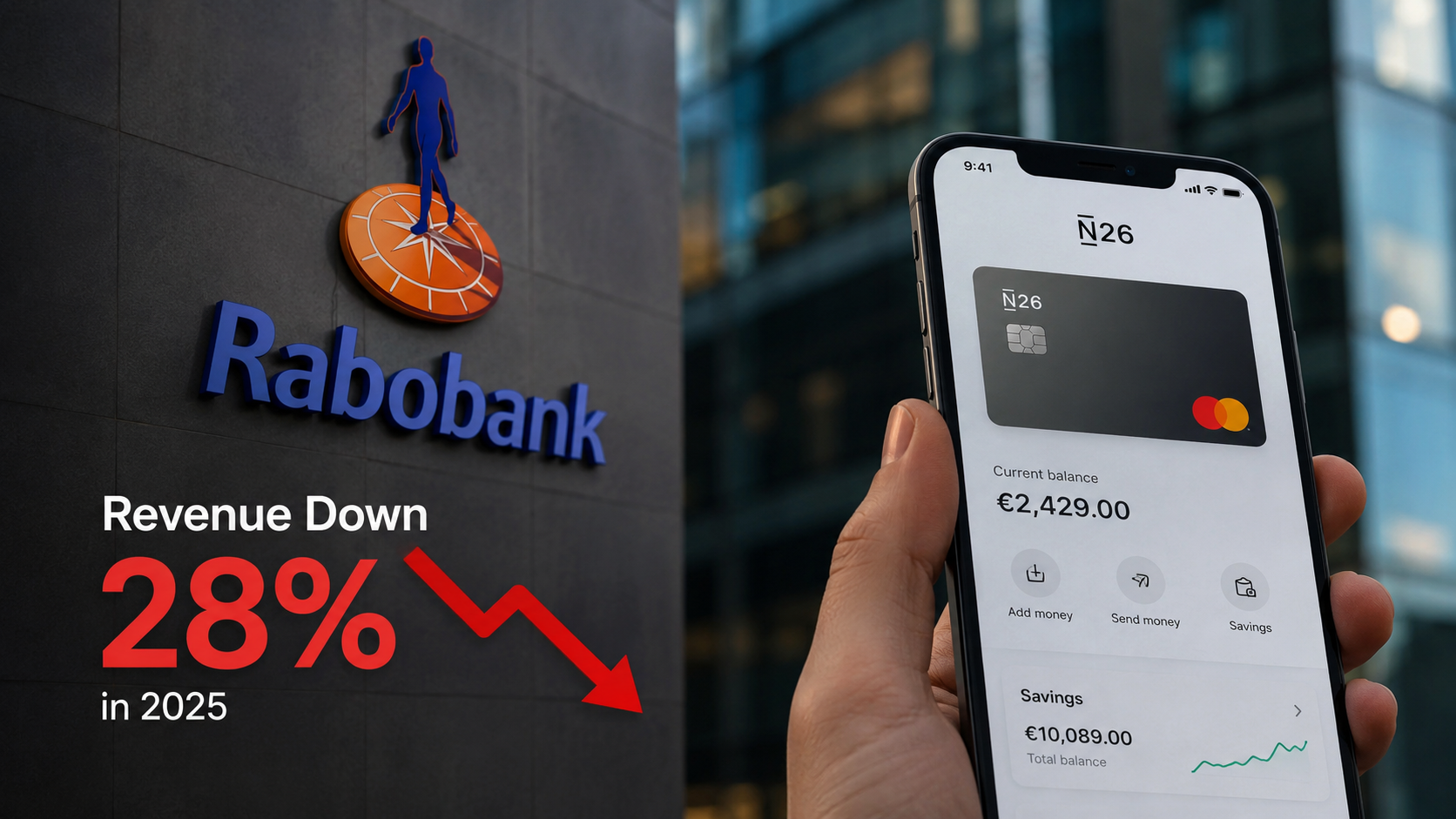
Traditional lender Rabobank saw its revenue drop by more than a quarter in 2025 as retail and small-business customers migrated en masse to digital-first neobanks like N26, citing higher interest rates, faster apps, and superior customer support.
A shifting tide in European banking
Rabobank’s latest annual report revealed a 28% decline in revenue for the 2025 fiscal year — one of the steepest drops among legacy European banks in the past decade. The Dutch financial giant, long considered a stable pillar of the Netherlands’ agricultural and retail banking sectors, attributed the fall to deposit outflows, shrinking net interest margins, and a significant exodus of both retail and small-to-medium enterprise (SME) clients.
The report, published Monday, showed that Rabobank lost approximately €4.2 billion in deposits between January and December 2025. More concerning for executives: the outflow accelerated in the fourth quarter, suggesting no immediate stabilization.
Meanwhile, neobanks continue to post record user growth. Berlin-based N26 added over 2.5 million new customers in Europe during the same period, many of whom transferred accounts directly from traditional banks. Rivals Revolut and Bunq also reported double-digit customer gains. Revolut’s European user base grew by 32% year-over-year, while Bunq saw a 41% increase in premium account holders.
Why customers are leaving
Surveys commissioned by Rabobank’s own internal strategy team — and leaked to financial news outlets last week — show three primary reasons for the switch.
Higher interest rates on savings
Neobanks are currently offering up to 3.8% APY on euro deposits in flexible savings accounts, with some promotional rates reaching 4.2% for locked three-month terms. Rabobank’s standard savings rate has remained between 0.75% and 1.5% throughout 2025. For a customer with €50,000 in savings, that difference translates to roughly €1,500 per year in foregone interest — a meaningful sum for middle-class households.
Faster, more reliable apps
Digital banks boast sub-second load times, biometric-only login flows, and 99.99% platform uptime. Rabobank’s mobile platform, by contrast, suffered three major outages in 2025 — one lasting over 11 hours during a Friday payday period — leaving thousands of customers unable to check balances or process transfers. User reviews on the Dutch App Store rate Rabobank’s app at 2.3 stars, compared to N26’s 4.7 stars.
Customer service that actually responds
Neobanks provide 24/7 in-app chat with average response times under two minutes for basic queries. Rabobank’s phone and email support averaged 48-hour resolution windows in 2025, with some customers reporting wait times of over a week for dispute resolutions. One customer who spoke to Dutch financial daily Het Financieele Dagblad described being put on hold for 53 minutes, only to be disconnected and told to “start a new request online.”
The N26 factor (and Revolut, and Bunq)
N26 has aggressively courted disillusioned legacy bank customers with a “Switch in 5 minutes” campaign that uses Europe’s new open banking APIs to automatically transfer direct debits, salary deposits, and recurring payments. The neobank also introduced instant sub-accounts offering 4% interest — a feature Rabobank does not currently match.
But N26 is not alone. Revolut’s “Pockets” feature allows users to create up to 20 distinct savings goals, each earning competitive interest. Bunq, the Dutch neobank, has directly targeted Rabobank’s home market with billboards reading: “Your grandfather banked with Rabo. You don’t have to.”
“We’re seeing a structural shift, not a blip,” said N26 CFO Jan-Niclas Jansen in an interview last week. “Customers have realized they don’t have to accept low rates and bad apps. The switching process used to take weeks. Now it takes five minutes on a lunch break.”
Rabobank’s response: branches closing, digital accelerating
In a statement accompanying the revenue report, Rabobank’s CEO acknowledged the disruption but pushed back on the revenue drop’s permanence:
“We are accelerating our digital transformation and will launch a revised savings product with competitive rates in Q1 2026. However, the 2025 figures reflect a real wake‑up call. We underestimated both the speed of customer migration and the emotional component of banking loyalty — which, we learned, is nearly nonexistent when there’s a €1,500 annual incentive to leave.”
The bank plans to cut 1,200 branch locations across the Netherlands, Belgium, and Germany — roughly 40% of its physical footprint — and retrain approximately 3,500 branch staff for digital support and remote advisory roles. Rabobank also announced a €250 million technology investment fund, focused entirely on rebuilding its mobile app from the ground up.
However, critics note that similar promises were made in 2022 following a smaller 6% revenue dip. “This time is different only because the numbers are too large to ignore,” said one former Rabobank product manager, speaking anonymously. “But the bank’s culture remains deeply branch-first. You can’t fix that with a press release.”
Market implications: the canary in the coal mine
Analysts warn that Rabobank may not be alone. Several other European traditional banks — including Germany’s Commerzbank, France’s Crédit Agricole, and Spain’s CaixaBank — are expected to report similar or worse revenue declines for 2025 when they release earnings in the coming weeks.
“This is the canary in the coal mine,” said Maria Fontana, a fintech analyst at Mediobanca. “If incumbents don’t match neobank rates and app experiences within 12 months, we’ll see an irreversible tipping point. Not a slow decline — a stampede.”
Preliminary data from the European Banking Authority shows that neobanks collectively held 14% of all eurozone retail deposits by December 2025, up from just 6% in 2022. At current growth rates, that share could reach 25% by the end of 2027.
What happens next
For Rabobank, the next six months are critical. The promised Q1 2026 savings product will need to offer rates within 50 basis points of neobank leaders to slow the outflow. Separately, the bank is exploring a partnership with a white-label neobanking platform to launch a “Rabobank Digital” sub-brand — though internal debates over branding and cannibalization of existing products have reportedly delayed the project.
For customers, the message is clear: loyalty is dead. The European retail banking market is now a hypercompetitive utility, and price — in the form of interest rates — is once again king.
Related stories
Man Loses €1.5 Million Following ChatGPT Investment Advice: Are We Trusting AI Too Much?
A European investor emptied his savings into a high-risk crypto portfolio suggested by ChatGPT — only to watch it vanish in six weeks. The case sparks a urgent debate: are we outsourcing critical thinking to machines that don’t actually understand money?

Japan’s ruling party advances proposal to build national AI-blockchain financial system
Japan's ruling Liberal Democratic Party has formally approved a policy proposal to develop a national financial system leveraging blockchain and artificial intelligence, signaling a significant push for digital modernization.

Inside Canada’s Bank Fraud Departments: Former Employee Reveals Manipulation Tactics Used Against Customers
A former fraud department employee at a major Canadian bank claims internal systems routinely pressured customers into accepting losses, delayed reimbursements, and prioritized institutional protection over victim recovery.