
The Jobs Mirage: How Dutch Banks Exploit Suriname for Profit
They call it job creation. We call it a cynical cost-cutting scheme that leaves ordinary people on both sides of the Atlantic paying the price.
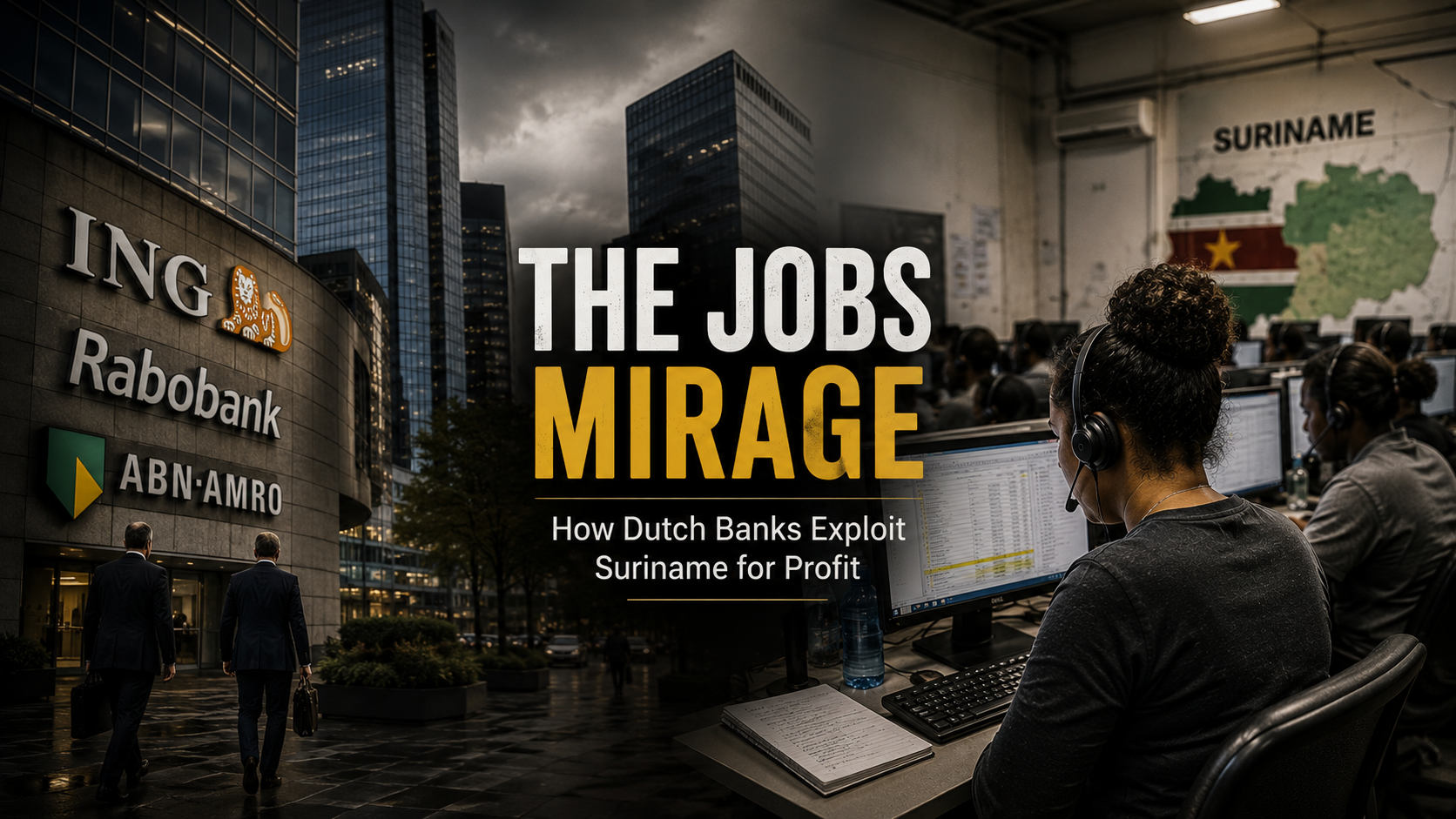
For years, the Dutch banking sector has polished its image with glossy campaigns about sustainability, inclusion, and “putting customers first.” But a quiet, almost invisible operation in the forests of Suriname tells a very different story—one of ruthless self-interest, regulatory evasion, and the casual sacrifice of ordinary people on the altar of quarterly earnings.
According to internal documents and interviews with former employees, several major Dutch banks have secretly transferred thousands of fraud-detection jobs to Suriname over the past five years. On paper, it sounds almost noble: “creating thousands of jobs” in a former colony. But peel back the veneer, and you’ll find a system designed solely to protect bank profits—not to help Surinamese workers, and certainly not to protect Dutch customers from fraud.
Let’s be clear: these are not high-skilled, fairly compensated positions. Workers in Paramaribo—many of them young, desperate, and earning a fraction of a Dutch minimum wage—are hired as “fraud analysts” on temporary contracts with no benefits, no union representation, and shifts that rotate without notice. They sit in open-plan call centers, monitoring transaction alerts for ING, Rabobank, and ABN AMRO. Their job? To flag suspicious activity. Their training? Often less than two weeks. Their pay? As low as €300 per month—less than a Dutch banker spends on a single business lunch.
Meanwhile, back in Amsterdam, the same banks publicly boast about their “advanced AI fraud systems” and “industry-leading security.” But the truth is that AI is expensive. Humans in Suriname are cheap. And that’s the only math that matters to a sector that has spent decades putting shareholder value above human dignity.
What does this mean for ordinary people? For a small business owner in Rotterdam whose account is frozen because an underpaid, overworked analyst in Suriname clicked the wrong box, it means days of lost income and zero accountability. For a pensioner in Groningen who falls victim to a phishing scam because the bank outsourced its oversight to a shoestring operation 7,000 kilometers away, it means sleepless nights and an endless phone queue. The banks save millions; customers pay in stress, time, and stolen money.
And let’s not pretend the Surinamese workers are winning, either. These are not the “quality jobs” that development economists dream of. They are burnout factories. Turnover exceeds 40% annually. Mental health support is nonexistent. One former team leader, speaking on condition of anonymity, told us: “We were told to treat every alert as ‘probably fraud’ until proven otherwise. The goal was to close cases fast—accuracy was never the metric. The banks wanted volume, not justice. If we flagged too few, we were penalized. If we flagged too many, the Dutch customer got angry, but that was someone else’s problem.”
This is the banking playbook in 2026: externalize risk, internalize profit. By moving fraud detection to Suriname, Dutch banks achieve three selfish objectives at once. First, they slash labor costs by more than 70% compared to keeping the work in the Netherlands. Second, they create a legal and geographical buffer zone—when things go wrong, they can blame “a third-party vendor in a distant jurisdiction.” And third, they pocket the difference as bonuses for C-suite executives who have never missed a mortgage payment in their lives.
The irony is as thick as crude oil. The same banks that refuse to lend to struggling Dutch families without exhaustive credit checks, the same institutions that foreclosed on homes during the 2008 crisis and paid fines for money laundering, now wrap themselves in the language of “international development.” They issue press releases about their “commitment to Suriname’s economy.” They pose for photos with local politicians. They never mention that the average Surinamese fraud analyst would need to work two full months to earn what a Dutch branch manager makes in a single day.
And what of the regulators? De Nederlandsche Bank (DNB) has been conspicuously silent. When we asked whether outsourcing fraud detection to a low-wage country complied with consumer protection rules, a spokesperson offered a bureaucratic shrug: “Banks are responsible for their own operational decisions as long as they meet minimum security standards.” In other words: the fox is not only guarding the henhouse—he’s franchising it.
Ordinary people deserve better. A fraud department is not a back-office cost to be minimized. It is the last line of defense between a family’s savings and organized crime. When banks treat that function as a commodity to be auctioned to the lowest bidder, they are not innovating. They are abandoning their duty of care.
Make no mistake: if these banks truly wanted to create jobs in Suriname, they would pay fair wages, provide real training, and integrate the work with transparent accountability. They do none of those things. Because the goal was never to help Suriname. The goal was to help themselves—quietly, cheaply, and without the Dutch public ever asking where their fraud alerts are really being handled.
So here is the question every ING, Rabobank, and ABN AMRO customer should ask today: When you call your bank’s fraud hotline, is the person on the other end empowered to help you—or are they just another cost-saving measure, trapped in a windowless office in Paramaribo, racing through your case so they can afford dinner?
The banks won’t answer that. They’re too busy counting their savings. And that, more than any single job created or destroyed, is the true scandal.
Related stories
Danske Bank Faces Revenue Pressure as Customers Move Toward Digital Assets
Traditional banking giants are feeling the squeeze as retail and institutional clients shift capital to crypto alternatives. Danske Bank becomes the latest European lender to flag revenue headwinds from digital asset outflows.

More than 32,000 bank employees barred from investing in crypto
Thousands of employees at Denmark’s largest banks are prohibited from investing in cryptocurrencies due to concerns tied to money laundering, criminal activity, and compliance risks.
Ohio Man Gets 9 Years for $10M Bitcoin Trading Ponzi Scheme
An Ohio investment manager received a nine-year prison sentence for a $10 million cryptocurrency Ponzi scheme, highlighting increased enforcement against digital asset fraud.